
Crate Training
Houston TX
Get started with CJ's Dog Training's crate training in Houston, TX, today! We are so sure that we can fix your dog problems that we actually offer guaranteed results and continued guidance for the lifetime of your dog. We will be by your side to help you with your dog every step of the way whether you have a new puppy or an older dog. Claim your free consultation to get started!
Why Crate Training Matters (Even If Your Dog Has the Run of the House)
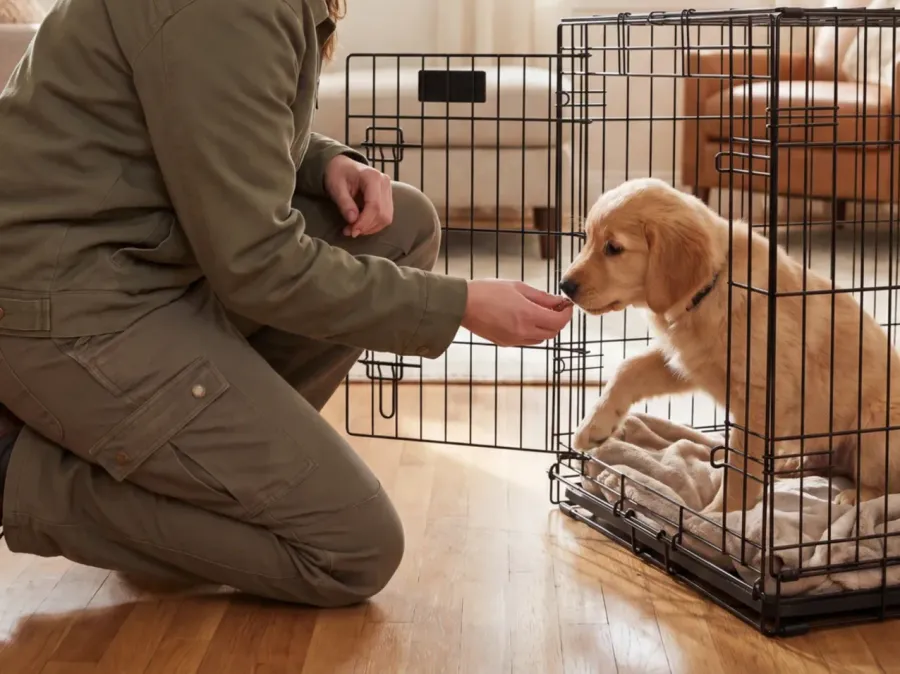
Dogs are den animals, they're hardwired to seek out small, enclosed spaces where they feel safe. A correctly introduced crate becomes that den: their favorite spot to nap, the place they retreat to when the household gets loud, the space they're calm in during travel or vet visits. Beyond comfort, the crate is the single most powerful tool for potty training puppies, preventing destructive chewing in adolescent dogs, and managing safe alone-time. Houston-area owners who skip crate training tend to deal with separation anxiety, destructive chewing, and counter-surfing for years. Owners who get crate training right have dogs that calmly handle travel, visitors, vet stays, and emergency situations like hurricane evacuations.
Choosing the Right Crate Size
The right crate is just big enough for your dog to stand up, turn around, and lie down comfortably, not bigger. A too-large crate teaches puppies that one corner can be a bathroom and the other corner can be a bed, which sabotages potty training. For growing puppies, buy the adult-size crate but use a divider panel to shrink the usable space until your puppy grows into it. Wire crates with a tray are easiest to clean. Plastic airline crates feel more den-like and work well for nervous dogs. Soft-sided crates are travel-only, chewers and escape artists destroy them.
How We Crate Train Step by Step
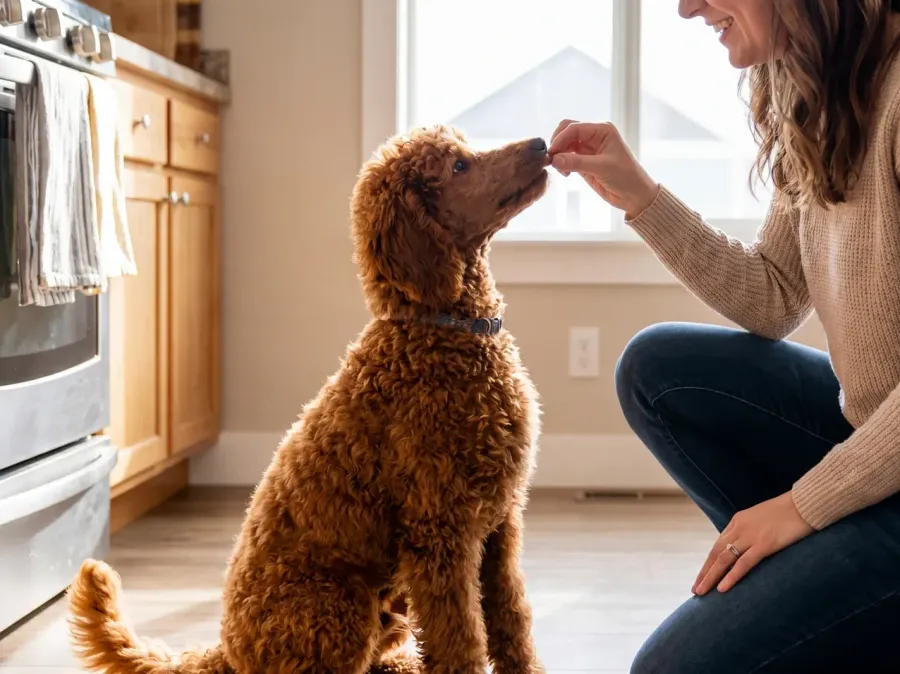
Step one is making the crate amazing, meals served inside, favorite toys appearing only when the puppy goes in, never closing the door at first. Step two is short closed-door sessions while you're in the room, gradually building duration. Step three is closed-door sessions while you're elsewhere in the house. Step four is closed-door sessions while you leave for short, then progressively longer, periods. Common issues we work through:
- Crying, whining, and barking when the door closes
- Refusing to enter the crate at all
- Anxiety-driven destructive chewing of bedding or the crate itself
- Soiling inside the crate (often a sizing or scheduling issue, sometimes a fear response)
- Rescues with severe crate phobia from past trauma
- Adult dogs who were never crate trained as puppies
Time Limits and What to Put Inside
Puppies under 6 months should not be crated more than 3 to 4 hours at a stretch, their bladders aren't ready and the experience can build negative associations. Adult dogs can comfortably crate for 6 to 8 hours, though we still recommend a midday break when possible. Inside the crate: comfortable but chew-safe bedding, a couple of favorite toys (avoid stuffies the dog might shred and ingest), and access to fresh water if the dog will be inside more than a couple of hours. Never use the crate for punishment, that breaks the positive association we worked to build.
Service Area
Crate training is included in every puppy program and available standalone for adult dogs and rescues across the Greater Houston: Houston, Pearland, Alvin, Friendswood, Manvel, Rosharon, Lake Jackson, League City, Dickinson, Texas City, Webster, Pasadena, Galveston, Santa Fe, and surrounding cities.
Why Houston-Area Owners Choose CJ's Dog Training
There are a lot of dog trainers in the greater Houston area. We're the one that handles the cases other trainers won't take, trains the handler as seriously as the dog, and stands behind the work with lifetime support. Here's what sets CJ's apart:
- Real behavior modification expertise, including aggression, reactivity, and severe anxiety cases
- Customized training plans built for your dog's specific behavior, breed, and household
- Local Houston-metro expertise across Brazoria and Galveston counties, we know the parks, the patios, the apartment complexes
- Balanced, science-informed methodology, no shock-collar shortcuts, no dominance theory
- Dog Training. Human Coach., every program coaches the household, because trained dogs need trained humans to stay trained
- Lifetime support included with every program
Our Promise
Your relationship with CJ's Dog Training doesn't end when your formal training program does. We make two promises that reflect how we run this business:
Lifetime Support
Reach out any time with questions
Guaranteed Results
If your case isn't a good fit for our programs
Our Training Philosophy
Most behavior issues, leash reactivity, resource guarding, separation anxiety, recall failures, come down to a communication breakdown between the dog and the human. Our job is to fix that. We use a balanced, relationship-based methodology grounded in clear communication, structured routines, and real-world practice. Three pillars guide every program:
Communication
Dogs read energy, body language, and consistent patterns. We coach handlers to send signals their dog actually understands, instead of repeating verbal cues that mean nothing.
Structure
Predictable routines, clear expectations, and consistent boundaries make dogs calmer and more confident. Structure isn't rigidity, it's the framework that lets your dog relax.
Real-World Practice
Training happens in real Houston neighborhoods, real parks, real homes, where the behavior actually has to work. Sterile training rooms produce dogs that fall apart on a real walk.
Frequently Asked Questions
How long does crate training take?
Puppies often adapt within 2 to 4 weeks of consistent positive crate work. Adult dogs and rescues with negative crate history may take 6 to 8 weeks or longer to build a positive association. Don't rush, a forced crate experience makes things permanently harder.
Is crate training cruel?
No. When introduced correctly with positive associations, the crate satisfies your dog's natural instinct for a den-like space. The crate becomes their safe spot, not a confinement. The cruelty comes from misuse, using it as punishment, leaving a dog in too long, or forcing a fearful dog inside without conditioning.
What size crate should I buy?
Just big enough for your dog to stand up, turn around, and lie down comfortably. Buy the adult-size crate for puppies and use a divider panel to shrink the space until they grow.
How long can my dog stay in the crate?
Puppies under 6 months: 3 to 4 hours max. Puppies 6 to 12 months: 4 to 6 hours. Adult dogs: 6 to 8 hours, though we recommend a midday break when possible. Senior dogs: shorter, depending on bladder control.
My rescue dog is terrified of crates, can crate training still work?
Yes, but it takes patience. We build positive crate associations slowly with high-value food, never force the door closed in early sessions, and work at the pace your dog can handle. Some severely traumatized rescues do better with an exercise pen or gated room as a long-term alternative.
Should the crate door be left open during the day?
Yes, when you're home and supervising. Open-door access lets your dog choose to go in for a nap and reinforces the crate as a positive space. Close the door for confined sessions during structured training, alone time, and overnight sleep.
Can crate training help with separation anxiety?
Crate training is a piece of the puzzle, but true separation anxiety is a panic disorder that requires its own behavior modification protocol, not just a crate. Forcing a separation-anxious dog into a crate without addressing the underlying anxiety often makes things worse. We assess each case at the consultation.
Ready to Get Started?
Book your free consultation. We’ll talk through your dog’s behavior, your goals, and the right program to get there.